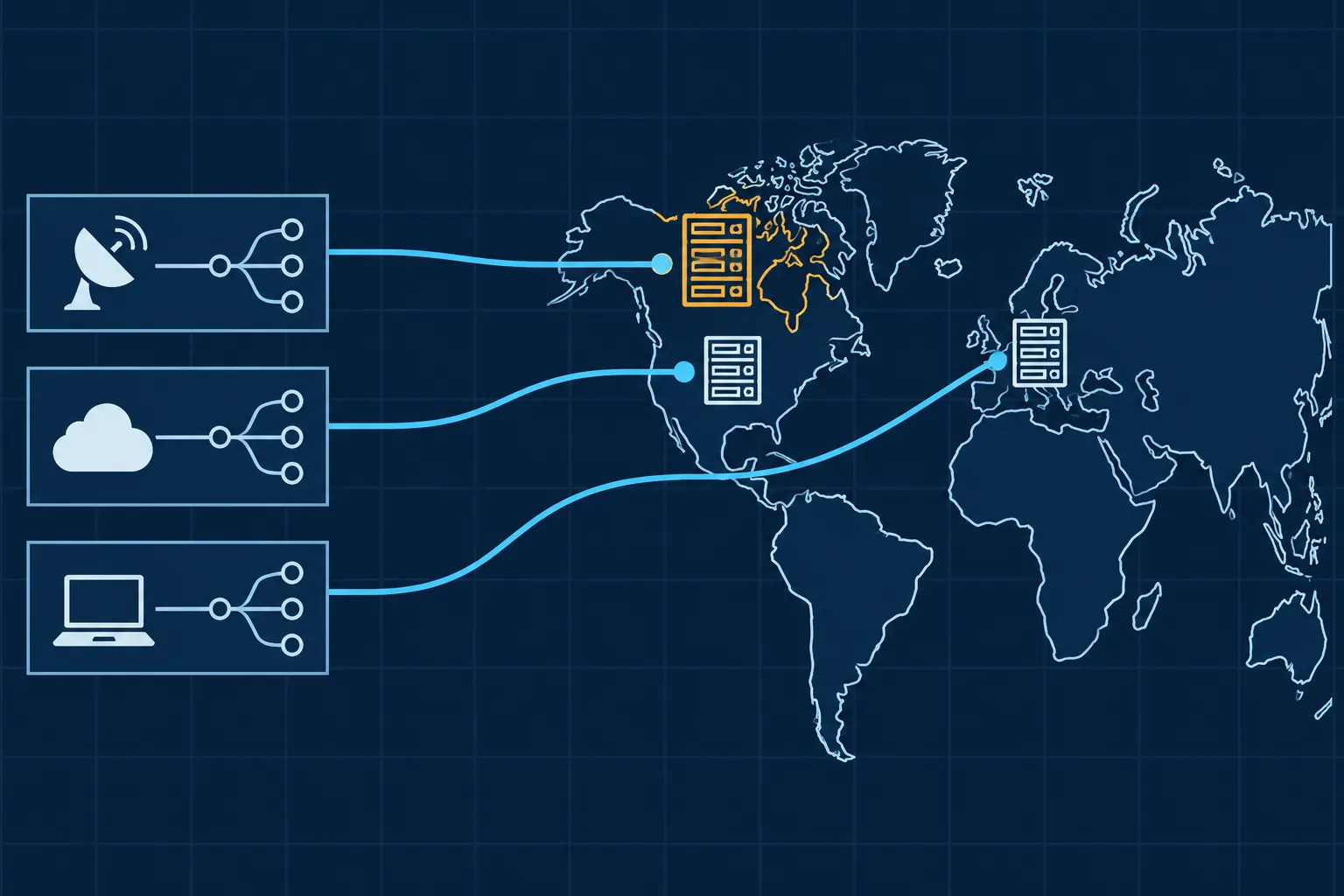
Zapier stores workflow data on AWS in the United States, Make offers US or EU data zones, and n8n Cloud runs on Microsoft Azure in the European Union. None has a Canadian region. SwiftBiz's verdict: self-host n8n in a Canadian cloud region for data that must stay in Canada; otherwise PIPEDA does not prohibit any of the three, provided you disclose the transfer and protect the data by contract.
Methodology: we build workflows on all three tools, and we analysed each vendor's own security, legal, sub-processor and documentation pages on November 21, 2026; every figure below links to one of them. Below: a side-by-side table, what each tool keeps and for how long, what PIPEDA and Quebec's Law 25 ask of you, and when self-hosting is worth the extra work.
Where do Zapier, Make and n8n store data?
| Zapier | Make | n8n Cloud | n8n self-hosted | |
|---|---|---|---|---|
| Hosting | AWS, United States | AWS: US zone, or EU zone (Ireland; Germany on Enterprise) | Microsoft Azure, European Union (e.g. Germany, Sweden) | Wherever you put it, e.g. AWS ca-central-1 or Azure Canada Central |
| Canadian region | No | No | No | Yes, your choice |
| Run data kept in the app | 29 to 69 days by default | Log data 30 days by default | 7 days (Starter) or 30 days (Pro); unlimited on Enterprise | 14 days or 10,000 runs by default, configurable |
| Can you shorten it? | Yes, on higher plans (7 to 30 days on Enterprise) | Yes: "Keep data confidential" stores no payload | Yes: stop saving successful runs | Yes, fully |
| Backups / logs | Up to 4 months in backups, 7 days in logs | Not stated on the security page | Not stated | Your backup policy |
| Certifications | SOC 2 Type II, SOC 3 | ISO 27001, SOC 2 Type II, SOC 3 | SOC 2 report (Enterprise), SOC 3 | Inherits your host's |
| DPA | Standard Zapier DPA; won't sign yours | DPA incorporated in the terms | Pre-signed DPA to countersign | Not needed for n8n itself |
| Our pick for | Low-sensitivity data, non-technical teams | Teams that prefer EU hosting | AI-heavy work where EU hosting is fine | Health, legal, financial or Quebec data |
The short answer to "where does Zapier store data": Zapier's security and compliance page says "Zapier stores data on Amazon Web Services (AWS) in the United States." There is no region picker. The others differ in the details below.
What does Zapier keep, and for how long?
Zapier keeps two kinds of run data: Zap Content (the actual records that pass through each step) and Zap Runs (metadata such as run times and status). Its data retention and deletion page, updated April 17, 2026, gives the same schedule for both: 7 days in logs, 29 to 69 days in your Zapier account, and up to 4 months in backups. Data you send while testing a Zap stays until you delete that Zap.
You can shorten the in-account period, but only on higher plans. Zapier's help article on custom retention says retention "can be customized to 7-30 days long" on the Enterprise plan, and the legal page says Company or Enterprise users can set a shorter period. The same legal page lists backups separately, at up to 4 months.
Zapier's subprocessor list, posted November 13, 2026, names AWS with a location of "USA" and lists about 25 infrastructure vendors, nearly all in the US. Zapier Automation Inc. in Canada appears only as an affiliate, not as a hosting location. Zapier holds SOC 2 Type II and SOC 3 reports and offers its own DPA, but its data privacy FAQ says it can't sign other companies' DPAs.
Verdict: Zapier is the clearest case. Everything is in the US, so you treat it as a cross-border transfer every time.
Not sure which of your workflows can leave Canada? Book an AI Readiness Audit ($3,500 CAD, credited toward your retainer); it can be scoped to include a map of each workflow, the personal information it touches and where every tool in it sends that data.
Can Make keep my data in Canada?
No. Make's AI providers and data zones page lists four zones, US1, US2, EU1 and EU2, and maps them to the United States and the European Union. Make's current sub-processor list (effective December 12, 2025, linked from its terms and conditions) says the AWS hosting location "can be selected by customer": the United States, or Germany for Enterprise and Ireland for other plans.
Two caveats matter for compliance work. First, the same data zones page warns that choosing an EU zone "does not automatically mean every request gets processed and stays in the EU": Maia and every OpenAI model in Make's AI Provider go to the US regardless of zone. Second, picking an EU zone does not make the data Canadian. It is still a transfer out of Canada.
On retention, Make's security page says "By default, log data is stored for 30 days," with longer storage on Enterprise. The useful control is per scenario: Make's scenario settings option "Keep data confidential" means "Make won't retain any of that data"; logs show the run happened but not the payload. The trade-off, in Make's words, is "very limited options to solve errors." Make reports ISO 27001 certification and completed SOC 2 Type II and SOC 3 audits.
Verdict: Make gives you more control than Zapier (EU hosting, a no-payload switch), but no Canadian option.
Where does n8n Cloud store data?
n8n Cloud runs on Microsoft Azure in the EU. Its security page says the hardware and stored data are "currently hosted in the European Union," and that n8n is "preparing to host in additional locations." The sub-processor list, updated September 22, 2026, gives Azure's processing location as the EU (for example Germany and Sweden) and lists OpenAI, Anthropic and LangChain as US-based for AI features, plus n8n US Inc. and n8n UK Ltd. for support.
Retention is the most transparent of the three. n8n's cloud data management docs state the limits per plan: Starter keeps up to 2,500 executions for 7 days, Pro up to 25,000 for 30 days, and Enterprise up to 50,000 with unlimited retention. You can switch "Save successful production executions" to "Do not save" per workflow or for the whole instance, so only failed runs are kept for debugging.
n8n offers a pre-signed DPA you download and countersign, a SOC 2 report for Enterprise customers and a SOC 3 report for everyone else.
Verdict: for data that can leave Canada, n8n Cloud has the shortest default retention, but it is still EU hosting.
Can I keep automation data in Canada with self-hosted n8n?
Yes, and it is the only option of the four that can. Self-hosted n8n runs on a server you choose, such as AWS Canada (Central), ca-central-1, or Canada West (Calgary), ca-west-1, listed in the AWS Regions documentation, or Azure Canada Central (Toronto) and Canada East (Quebec) in Microsoft's regions list. Our post on n8n workflows covers what it can build; this section only covers what keeps data local.
Three settings decide whether "self-hosted" really means "in Canada":
- Phone-home traffic. n8n's isolation docs say "a self-hosted n8n instance sends data to n8n's servers" by default. Set
N8N_DIAGNOSTICS_ENABLED,N8N_VERSION_NOTIFICATIONS_ENABLEDandN8N_TEMPLATES_ENABLEDto false, and unset the diagnostics configuration variables the same page lists. - Execution pruning. Pruning is on by default and deletes runs older than 336 hours (14 days) or past 10,000 executions, per the execution data docs. Shorten it to what your retention policy needs.
- Model calls. A Canadian server that calls a US-hosted AI model still sends the prompt to the US. Our PIPEDA-compliant AI automation guide compares which model APIs process prompts in Canada.
You also take on the vendor's job: patching, backups, encryption at rest and access control. n8n's security page says encrypting data at rest is the customer's responsibility on self-hosted instances.
Does PIPEDA allow storing data outside Canada?
Yes. The Office of the Privacy Commissioner's Guidelines for processing personal data across borders (2009) state: "PIPEDA does not prohibit organizations in Canada from transferring personal information to an organization in another jurisdiction for processing." Two duties come with it:
- Accountability. Under Principle 4.1.3, you stay responsible for information sent to a processor and must use "contractual or other means to provide a comparable level of protection." That is what the vendor DPA is for.
- Transparency. The guidelines say organizations must "make it plain" that information "may be processed in a foreign country" and may be accessible to that country's "law enforcement and national security authorities," in "clear and understandable language," ideally at the time of collection.
In practice, a privacy policy line naming the US (for Zapier or Make's US zone) or the EU (for Make's EU zone or n8n Cloud) does most of this work. The same guidelines note that some information may be "so sensitive that it should not be sent to any foreign jurisdiction," which is the case for self-hosting.
What changes if you handle Quebec residents' data?
Quebec adds a formal step. Section 17 of the Act respecting the protection of personal information in the private sector, as amended by Law 25, says: "Before communicating personal information outside Québec, a person carrying on an enterprise must conduct a privacy impact assessment." The assessment must consider the sensitivity of the information, its purposes, the protection measures "including those that are contractual," and the legal framework of the destination. The information may go only if the assessment shows "it would receive adequate protection," and the transfer "must be the subject of a written agreement."
Section 17 applies equally when you entrust a body outside Québec with "collecting, using, communicating or keeping such information on his behalf," which is exactly what a hosted automation tool does. Section 8 also requires you, where applicable, to tell people about "the possibility that the information could be communicated outside Québec." The text says "outside Québec," not "outside Canada," so a server in Toronto is also outside Québec.
What are the downsides of self-hosting n8n?
Self-hosting is the only route to Canadian residency, but it is not free of cost or risk:
- You own security. A misconfigured server is a bigger privacy risk than a SOC 2-audited vendor. If nobody on your team patches servers, budget for someone who will.
- Fewer ready-made integrations than Zapier. Some apps need an HTTP request node rather than a one-click connector.
- Residency stops at your server. Every SaaS app the workflow touches (your CRM, email platform, AI model) has its own hosting location. Map those too.
Which should you choose?
- For marketing data, public information or internal notifications, choose whichever tool your team already uses. Disclose the US or EU transfer in your privacy policy and sign the DPA.
- For customer records where you prefer EU law over US law, choose Make on an EU zone with "Keep data confidential" on, or n8n Cloud with successful runs not saved. Avoid features Make routes to the US.
- For health, legal or financial records, or any data a contract or regulator says must stay in Canada, choose self-hosted n8n in ca-central-1 or Canada Central, with telemetry off and pruning set.
- For Quebec residents' data, write the section 17 assessment before the first workflow goes live, whichever tool you choose.
SwiftBiz designs and runs these builds through our AI workflow automation service; first production workflows typically go live in 4 to 8 weeks. For a fuller tool comparison on pricing and AI features, read n8n vs Make.com vs Zapier.