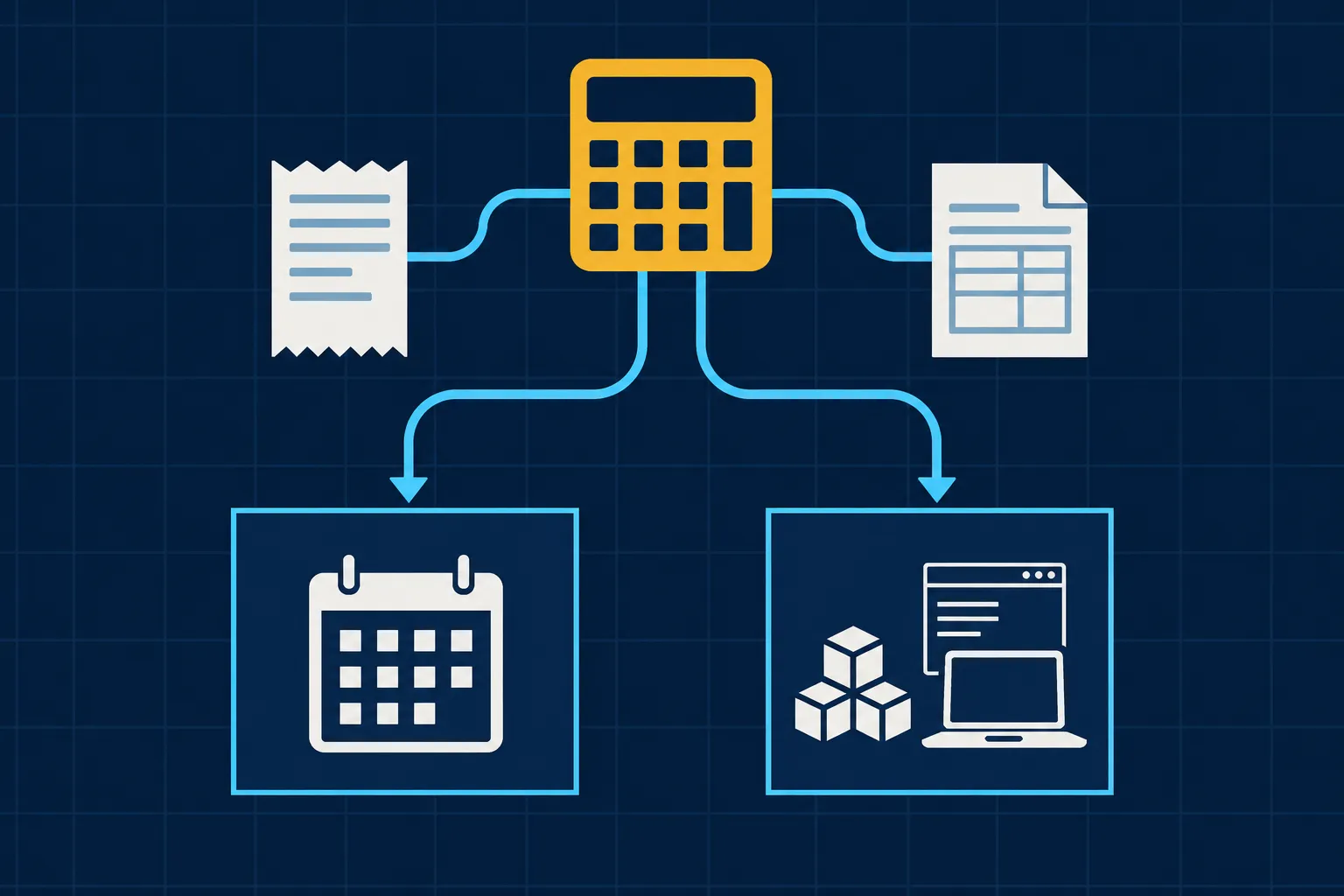
In Canada, most AI automation spending is a current expense: SaaS subscriptions and service fees are generally deductible, if otherwise deductible, in the fiscal year the service covers, with any prepaid portion carried to the year it relates to. According to the CRA's 2026 guidance, software you buy and own goes in CCA Class 12 at 100% and computers in Class 50 at 55%. Under the current Income Tax Regulations, both may qualify for a full first-year write-off.
For computers, the enacted Class 50 rule covers property in use before 2027. A federal proposal announced on September 15, 2026, the Productivity Mega Deduction, would make a full first-year write-off permanent for most depreciable property acquired on or after that date; it was proposed, and not yet in the consolidated Regulations when we checked on November 25, 2026. Every "may" in this post is our reading of the regulation text, for your accountant to confirm.
SwiftBiz sells AI automation to Canadian small businesses in CAD, from a $3,500 AI Readiness Audit to retainers starting at $4,500 per month, and "can I write this off?" is one of the first budgeting questions for a project like this. We are not accountants, so we read the primary sources instead: the CRA's guide pages and the Income Tax Regulations themselves, checked on November 21, 2026. Below: the decision table, what each category means, an illustrative year-one example at our real prices, and where HST and SR&ED fit.
Is software a capital expense or a current expense in Canada?
It depends on whether the payment buys something lasting. The CRA's current or capital expenses page puts the test in two lines: "A capital expense generally gives a lasting benefit or advantage," while "A current expense is one that usually recurs after a short period."
A current expense is deducted in full against income, generally in the fiscal year it relates to (a prepaid amount is spread over the period it covers). A capital expense is not deducted directly; it goes into a CCA class and you claim capital cost allowance, a set percentage per year, until the cost is used up.
For AI automation, the test sorts spending like this:
| What you pay for | Usual treatment | CCA class and rate | First-year write-off (our reading, see below) |
|---|---|---|---|
| SaaS and AI subscriptions (ChatGPT Business, Claude, Zapier, Make, a CRM) | Current expense | None | Deducted in full, in the fiscal year the subscription covers; split a prepaid annual plan that runs past your year-end |
| Monthly agency retainer for running and improving workflows | Usually current (professional services) | None | Deducted in full, in the fiscal year the service is delivered; ask about any part that builds software you own |
| One-time audit, strategy or consulting fee | Usually current (professional fees) | None | Deducted in full, in the fiscal year the work is delivered |
| Software licence you buy outright and keep | Capital | Class 12, 100% | Full cost, if acquired after 2024 and in use before 2034 |
| Custom software built for you that you own | Often capital (lasting benefit) | Class 12, 100%, if capitalized | Full cost, same conditions |
| Laptops, servers, GPUs and their operating system | Capital | Class 50, 55% | Full cost, if acquired after April 15, 2024 and in use before 2027; for later purchases see the September 2026 proposal below |
Are SaaS subscriptions and monthly retainers deductible?
Usually yes: they are generally current expenses if otherwise deductible. A monthly or annual subscription recurs after a short period and leaves you owning nothing when it stops, which is the CRA's description of a current expense. When you deduct it is a separate question. For the accrual method, the CRA's business expenses chapter of guide T4002 says to "claim the expense you prepay in the year or years in which you get the related benefit." So an annual plan paid in December for a term that runs into your next fiscal year is split between the two years: allocate the prepaid portion covering services after your fiscal year-end to the period it relates to.
We could not find a CRA page that names SaaS or cloud AI subscriptions specifically, so treat that as our reading of the general test, not a CRA ruling.
Service fees work the same way. The same T4002 chapter says "You can deduct the fees you incurred for external professional advice, services and consulting fees." It adds the exception that matters: "You cannot deduct legal expenses and other fees you incur to buy a capital property." So a fee paid to acquire a capital asset follows the asset, not the fee line.
That exception is why a retainer is "usually" current rather than always. If part of what you pay produces software your business owns and keeps using for years, your accountant may capitalize that part. For how an AI project budget breaks down by line, see how much AI automation costs in 2026.
What is CCA Class 12 and does the half-year rule apply to software?
Class 12 is the top-rate capital cost allowance class, and it is where application software goes. Schedule II of the Income Tax Regulations, paragraph (o) of Class 12, covers "computer software acquired after May 25, 1976, but not including systems software." The CRA's classes of depreciable property page says the same in plain terms: Class 12 at 100% is for "computer software that is not systems software."
The base rule is the half-year rule. That CRA page states "Software in Class 12 is subject to the half-year rule," which normally limits the first-year claim to half the cost. So a $10,000 software purchase would normally give $5,000 of CCA in year one.
The accelerated investment incentive changes that. Section 1104(4.01) of the Regulations defines "reaccelerated investment incentive property" as property "acquired by the taxpayer after 2024" that "becomes available for use before 2034" (with exclusions for some used property, such as property already depreciated by someone else and acquired from a non-arm's-length party). Section 1100(2) of the Regulations then leaves that property out of the half-year adjustment. Our reading of section 1100(2): for Class 12 software that qualifies, the 100% rate applies to the full cost in the first year.
Two cautions. First, the CRA's own accelerated investment incentive page still describes the older version (property acquired after November 20, 2018 and available for use before 2028) and was last updated July 21, 2025, so it lags the Regulations. Second, your fiscal year-end matters here, so confirm it before you plan cash flow around it.
What goes in Class 50, and can you write off a computer right away?
Class 50 is for hardware. Schedule II describes it as "general-purpose electronic data processing equipment and systems software for that equipment," which covers laptops, desktops, servers and the operating system that runs them. The CRA's classes page sets the normal rate at 55%, and the T4002 guide is blunt about the alternative: "If you buy a computer... you cannot deduct the cost" as an ordinary expense.
There is a temporary enhancement. Section 1100(2) of the Regulations gives Class 50 property "acquired and became available for use by the taxpayer after April 15, 2024 and before 2027" an extra first-year factor of 9/11. Multiplied out, 55% times (1 + 9/11) is 100%, so our reading is that a qualifying computer bought and put to use by December 31, 2026 can be written off in full in year one. It began as accelerated CCA for productivity-enhancing assets in Budget 2024, and Finance Canada's 2025 budget tax annex lists it among the previously announced measures it would proceed with. In the Regulations as consolidated to October 29, 2026, that extra factor is nil for property that becomes available for use after 2026. That does not settle what a 2027 purchase gets in its first year. The 55% class rate and the first-year allowance are separate things, the reaccelerated incentive still applies to qualifying property until 2034, and on September 15, 2026 Finance Canada proposed the Productivity Mega Deduction: permanent immediate expensing for most depreciable property acquired on or after that date. It was proposed with draft legislation, and was not yet in the consolidated Regulations when we checked on November 25, 2026. Ask your accountant how a 2027 addition will be treated before you time a purchase around December 31.
Two edge cases: systems software bought with hardware goes in Class 50, not Class 12, and cloud GPU time you rent by the hour is a service, not property, so it falls back into the current-expense row.
Is immediate expensing for CCPCs still available?
Not for new purchases. The immediate expensing measure is still in section 1104(3.1) of the Regulations, but its definition of immediate expensing property requires property that "becomes available for use... before 2024" for a Canadian-controlled private corporation (before 2025 for individuals and partnerships of individuals). Anything a CCPC puts into use now relies on the accelerated investment incentive instead. A separate federal proposal from September 15, 2026, the Productivity Mega Deduction, would bring immediate expensing back for most depreciable property on a permanent basis; see the Class 50 section above for its status.
That incentive was reinstated through the Budget 2025 implementation legislation. Finance Canada's 2024 Fall Economic Statement proposed it for property acquired on or after January 1, 2025, with an enhanced first-year allowance of up to 3 times the normal deduction through 2029, up to 2 times for 2030 to 2033, and the normal rate from 2034. The legislation, Bill C-15, the Budget 2025 Implementation Act, No. 1, received royal assent on March 26, 2026, and the reaccelerated rules now sit in the consolidated Regulations quoted above.
If you want a second opinion before you commit to a build, our AI Readiness Audit maps your workflows, costs and expected payback in CAD, so your accountant gets a scoped list of what you plan to buy and what you plan to subscribe to.
How would a year of AI automation be classified? A worked example
Here is how one year of AI workflow automation spending could sort out for an Ontario small business at SwiftBiz's published CAD prices. The classifications are our reading of the sources above.
| Line item | Cost (CAD, before HST) | Likely treatment |
|---|---|---|
| AI Readiness Audit | $3,500 (credited toward your retainer) | Current: professional fees |
| AI Starter retainer, 12 months | $4,500 per month, $54,000 | Current: services, unless part is capitalized |
| SaaS stack (LLM seats, automation platform) | $300 per month, $3,600 | Current: subscriptions |
| One laptop for the operations lead | $2,000 | Class 50; may be full cost in year one if in use by December 31, 2026 |
| Perpetual licence for a desktop OCR tool | $1,200 | Class 12; may be full cost in year one under the reaccelerated rules |
Illustrative example. The figures show what this build is designed to achieve, not a measured client result. The SaaS, laptop and licence amounts are assumptions for the example, not quotes. Because the audit fee is credited toward your retainer, what you are actually invoiced over the year is lower than the sum of the rows; your accountant books the invoices, not the list prices. For the full pricing, see our pricing page.
In this setup almost everything is a current expense, and on our reading the two capital items may qualify for a full first-year write-off. Classification mostly changes timing, not the total deduction.
How do HST input tax credits work on AI tools?
HST is a separate system from income tax. If your business is a GST/HST registrant, the CRA says on its input tax credits overview that "you recover the GST/HST paid or payable on your purchases and expenses" when they are "for consumption, use, or supply in your commercial activities." In Ontario that is the 13% HST on an invoice like our retainer.
Whether the income tax side treats the cost as current or capital does not decide the ITC. Capital personal property such as a laptop has its own percentage-of-use rules, so mixed personal and business use needs a conversation with your accountant. Foreign SaaS vendors that are not registered in Canada may not charge HST at all, which changes what you can claim.
Does SR&ED cover AI automation?
Rarely, for adopting existing tools. The CRA's SR&ED eligibility rules require a systematic investigation aimed at a technological advancement, and connecting a CRM to an LLM with a standard workflow platform is usually engineering practice, not research. We covered SR&ED and the other programs in AI grants for Canadian small businesses.
When does the classification actually matter, and who is this not for?
Three decision rules from the sources above:
- For subscriptions and service retainers, expect current-expense treatment and keep contracts that describe ongoing service, so the classification is easy to support.
- For a large custom build you will own, start with your accountant before you sign. If it is capitalized as Class 12 software and qualifies under the reaccelerated rules, the first-year claim may still be the full cost, but the paperwork differs.
- For hardware, confirm the rule before you time a purchase. The enacted Class 50 full first-year write-off needs the computer acquired after April 15, 2024 and in use before 2027. The September 2026 Productivity Mega Deduction proposal would extend immediate expensing past that date, so ask your accountant which rule applies to your purchase date.
This guide is not for software companies building AI products for sale, businesses with SR&ED claims, or anyone outside Canada; their rules need a specialist. Its main limitation is that it covers federal income tax and HST only, not provincial credits. If you are building the internal case for an AI project, our AI automation business case template has room for the tax line; fill it in with your accountant, not from a blog post.