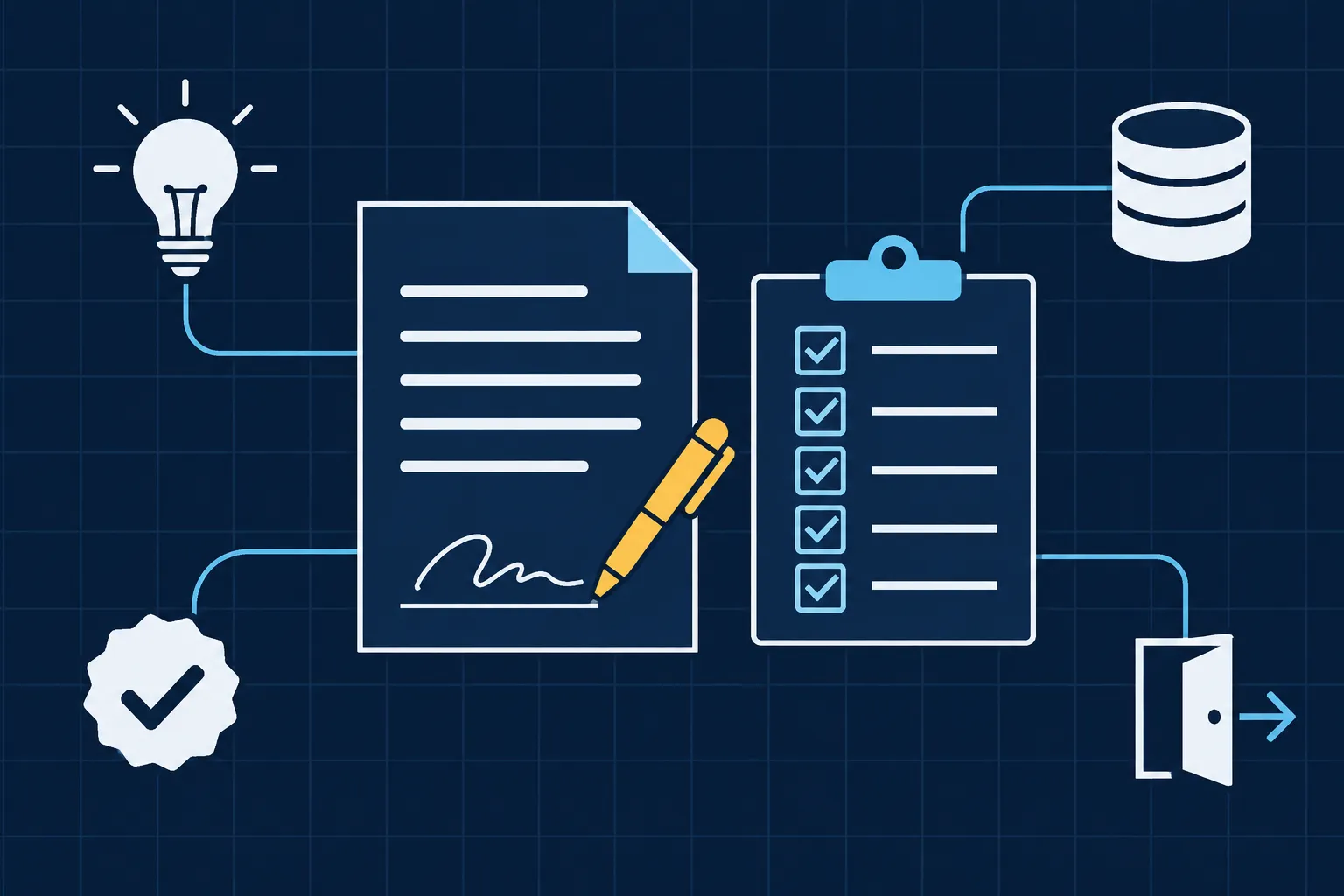
Under section 13(1) of Canada's Copyright Act, the author of a work is the first owner of its copyright, and code counts as a literary work. So if you hire an AI automation agency without a signed written assignment, the agency can end up owning the workflows you paid for. This 8-step checklist covers IP, data, acceptance tests, SLAs and exit before you sign.
SwiftBiz is an AI automation agency in the GTA, and our founder, Harry, spent 10+ years as a senior SDET building and testing enterprise software, so we read these clauses from the side that has to build and hand over the work. How we built this checklist: we read the statute sections and vendor pages linked below in full, and quoted them rather than paraphrasing. Below: the ownership rules, then eight clauses to check in order, how to know the contract is complete, and what usually goes wrong.
Who owns AI automation code by default in Canada?
The person who wrote it, unless an employment relationship or a signed document says otherwise. The Copyright Act sets four rules that matter here:
| Section | What it says (quoted) | What it means for your contract |
|---|---|---|
| s. 13(1) | "the author of a work shall be the first owner of the copyright therein" | Whoever writes the code or workflow owns it first |
| s. 13(3) | Applies where the author "was in the employment of some other person under a contract of service or apprenticeship", "in the absence of any agreement to the contrary" | Your own employees' work is yours by default; an outside agency is usually not your employee |
| s. 13(4) | "no assignment or grant is valid unless it is in writing signed by the owner of the right" | A handshake does not transfer ownership, and an informal email may not either |
| s. 14.1(2) and (3) | Moral rights "may not be assigned but may be waived"; an assignment "does not by that act alone constitute a waiver" | You need a waiver as well as an assignment |
The definitions section of the same Act says a "literary work includes tables, computer programs, and compilations". An agency you hire normally works under a contract for services, not a contract of service, so the s. 13(3) employment rule generally does not move ownership to you. If the agency's own employees write the code, the agency is likely the first owner, and it then has to assign to you in a signed writing.
What do you need before you start?
Gather these before the first contract draft arrives:
- A list of what you are buying: workflows, chatbot, integrations, prompts, dashboards, documentation. You can't assign what nobody named.
- A data map: which systems the build touches and which hold personal information (CRM, inbox, booking tool, accounting).
- Your accounts list: which SaaS and AI accounts should be in your company's name (n8n or Make, OpenAI or Anthropic, Twilio, hosting).
- Three to five real test cases per workflow: a real input and the output you expect.
- A lawyer's hour booked for the final review.
Step 1: Does the contract assign IP and waive moral rights?
Ask for an assignment of all custom deliverables, written and signed, because s. 13(4) makes an unsigned transfer invalid. An assignment makes you the owner; a licence only lets you use something the agency still owns, and a narrow licence can stop you hiring a different team to change it.
Our verdict: choose an assignment for anything built for you, and accept a licence only for the agency's reusable background tools (Step 2).
Check that the clause names "Deliverables" broadly: source code, n8n or Make workflow files, prompts and system prompts, retrieval settings, test suites and documentation. Whether a prompt or a workflow configuration attracts copyright on its own is not settled, so define it as a deliverable in the contract and stop relying on copyright to carry it.
Get the moral rights waived too. Ask for a written waiver of moral rights from every individual author, or a promise from the agency that it has obtained one. Under s. 14.1(1) the author keeps the right to the integrity of the work and to be associated with it, and s. 14.1(3) says an assignment alone does not waive those rights. Section 14.1(4) helps: a waiver made in favour of the owner or a licensee "may be invoked by any person authorized by the owner or licensee to use the work", so your future contractors are covered too.
Step 2: How is pre-existing (background) IP handled?
Accept that a capable agency reuses its own libraries, templates and node patterns, and require a licence to them that survives the contract. The clause should list background IP in a schedule, grant you a perpetual, royalty-free, non-exclusive licence to use and modify it inside your deliverables, and allow a replacement vendor to work on it for you. A background-IP carve-out with no licence attached is how a "you own everything" contract turns into a workflow you can't legally edit.
Step 3: Who owns your data, and can the agency or a model train on it?
Write it plainly: your inputs, outputs and records stay yours, the agency uses them only to deliver the service, and nobody trains or fine-tunes a model on them without your written consent. Then check the AI vendor's terms too. OpenAI's business data page states "We do not train our models on your data by default" for its API Platform and business plans; the clause should require the agency to keep those defaults and tell you before switching to a vendor with different terms. Add confidentiality that covers prompts, test data and anything the agency sees in your systems, with return or deletion at the end.
Step 4: Does the agency meet your PIPEDA obligations as a service provider?
It has to, because the law keeps the responsibility with you. PIPEDA Schedule 1, clause 4.1.3 says an organization "is responsible for personal information in its possession or custody, including information that has been transferred to a third party for processing" and "shall use contractual or other means to provide a comparable level of protection". In practice, ask for: purpose limits, named sub-processors (including the AI vendor and where it stores data), security safeguards, breach notice to you, and deletion on exit. Our PIPEDA-compliant AI automation guide covers the build side.
Step 5: What are the acceptance criteria and test cases?
Attach the test cases to the contract and define "accepted" as passing them. A sample acceptance row looks like this:
| Workflow | Test input | Expected result | Pass threshold |
|---|---|---|---|
| Invoice intake | 20 real supplier PDFs | Vendor, date, total and PO written to the accounting draft | 19 of 20 correct, failures flagged for review |
| Lead routing | 10 web-form leads across 3 regions | Each assigned to the right rep, CRM record created | 10 of 10 |
| Chatbot FAQ | 30 questions from your inbox | Answer matches your policy page or hands off | No invented policy answers |
Illustrative sample rows, not taken from a client contract: replace them with your own inputs and thresholds.
Give yourself a fixed review window (for example, ten business days), say what happens when a test fails (fix and retest at no charge), and treat AI outputs as probabilistic: set a threshold, not a promise of perfection. Our guide to testing an AI chatbot before launch shows how to build the question set.
Step 6: What service levels apply after launch?
Put numbers on support: response times by severity, business hours or 24/7, how incidents are reported, and what monitoring runs. Separate what the agency controls (its code, its hosting) from what it does not (an OpenAI or Anthropic outage), and name who pays for usage-based API costs.
Step 7: What happens when a model or vendor changes?
Require notice and a migration plan, because models are retired on the vendor's schedule. Anthropic's model deprecation policy promises "at least 60 days' notice before model retirement for publicly released models", and after retirement "requests to it fail." The clause should say who tracks these notices, that a swap gets re-run against the Step 5 acceptance tests, whether migration work is included or billed, and that the agency can't move your data to a new vendor without your approval.
Step 8: How do you exit and get a clean handover?
Write the exit before you need it. The handover clause should list:
- Accounts in your name from day one, with admin access for you; credentials transferred and agency access removed on exit.
- Workflow exports: n8n "saves workflows in JSON format" per the n8n export docs, and Make exports scenarios as blueprints, which per Make's help centre carry modules, module settings and mapped values, but you still have to recreate connections after import.
- Prompts, test suites, data exports and documentation in usable formats.
- A transition period (for example, 30 days) of paid help to a new team, and deletion confirmation for your data.
Note the n8n docs also warn that exported JSON includes credential names and IDs, so plan a credential rotation at handover.
Want a second pair of eyes on what you are about to buy? Our AI Readiness Audit ($3,500, credited toward your retainer; all prices are in Canadian dollars) maps your workflows, data and accounts before any build starts, which makes these schedules much easier to write.
How do you know the contract is complete?
Run this check on the final draft. You should be able to answer yes to each:
- Every deliverable, including prompts and workflow files, is named and assigned in a signed document.
- Background IP is listed, with a perpetual licence that a replacement vendor can use.
- Moral rights waivers are covered.
- No training on your data without written consent; sub-processors are named.
- The acceptance tests are attached, with thresholds and a review window.
- Support response times and vendor-outage responsibility are written down.
- A model change triggers notice and re-testing.
- The exit clause lists accounts, exports, documentation, transition help and deletion.
Our buyer's checklist for evaluating an AI automation agency covers the step before this one: choosing who to sign with.
What usually goes wrong?
- "You own the deliverables" with no definition. Prompts, configs and test suites fall outside it.
- Accounts in the agency's name. Even with perfect IP terms, you can't operate what you can't log into.
- Acceptance by use. "Accepted once in production" removes your leverage to get fixes.
- One-sided limitation of liability that caps the agency at a month's fees while you carry the PIPEDA responsibility.
- No re-test rule for model changes. A silent model swap can change answers your customers rely on.
When it isn't worth negotiating hard: a one-off, low-risk automation built entirely inside your own n8n or Make account, touching no personal information. There, an assignment clause and an export list may be enough. For anything customer-facing or touching personal data, such as the builds on our AI workflow automation page, start with the full checklist.