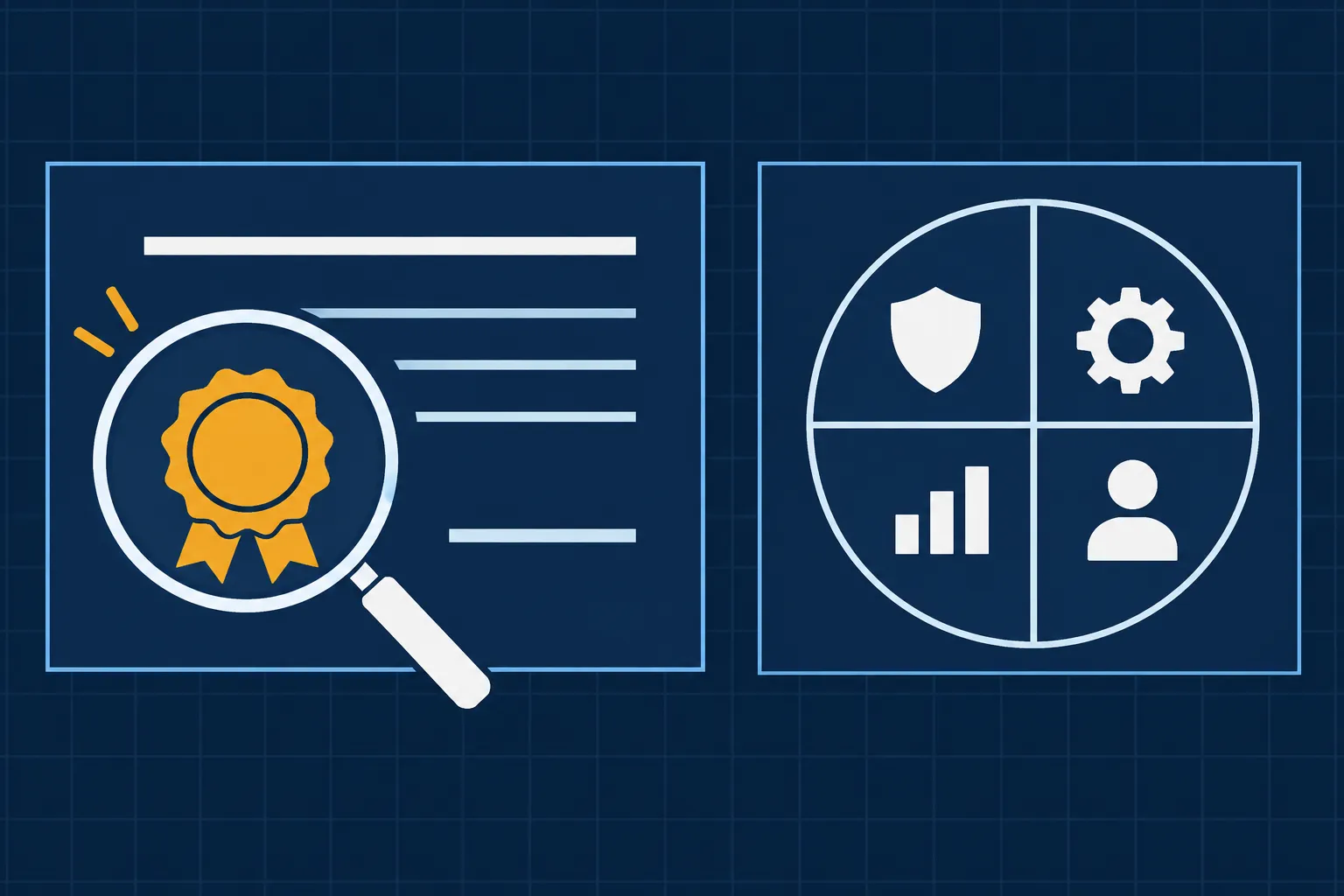
ISO/IEC 42001 is a management system standard that an accredited third party can audit and certify; the NIST AI Risk Management Framework is a voluntary U.S. framework with no certificate at all. So "ISO 42001 certified" can be checked against a named certifier and scope; "aligned with NIST AI RMF" is self-described.
SwiftBiz builds and tests AI chatbots and workflows for Canadian small and mid-size businesses, and we read vendor security packs as part of that work. SwiftBiz holds neither an ISO/IEC 42001 certificate nor any NIST attestation, so this is a buyer's reading, not a sales pitch. Method: we read the ISO, NIST and SCC primary sources linked below on November 21, 2026; all prices are in Canadian dollars (CAD). Below: a side-by-side table, what each word in a vendor's claim means, how to verify a certificate in Canada, and the questions to ask.
How do ISO 42001 and NIST AI RMF compare?
| Criterion | ISO/IEC 42001:2023 | NIST AI RMF 1.0 (+ AI 600-1) |
|---|---|---|
| What it is | Management system standard with "shall" requirements | Voluntary framework of outcomes and suggested actions |
| Publisher | ISO and IEC (JTC 1/SC 42), December 2023 | U.S. National Institute of Standards and Technology, January 26, 2023 |
| Can a vendor be certified? | Yes, by an accredited certification body | No. There is no NIST certificate or certification program |
| Strongest claim a vendor can honestly make | "Certified," with a certificate number, certifier and scope | "Aligned with" or "uses," backed by its own documents |
| What it covers | The organization's processes for governing AI (Plan-Do-Check-Act) | Risks of specific AI systems across four functions |
| Generative AI detail | General; not chatbot-specific | Generative AI Profile (NIST AI 600-1) lists 12 GenAI risks |
| Cost to read | CHF 225 from ISO | Free PDF from NIST |
| Best use for a buyer | Evidence an outside auditor checked the vendor's AI governance | A vocabulary to question how the vendor handles risk in your system |
Verdict: for proof that someone independent looked, choose an accredited ISO/IEC 42001 certificate as the stronger signal. For questions about how a chatbot will behave with your customers, the NIST framework and its Generative AI Profile give you better questions. Neither tells you the bot works.
What is ISO/IEC 42001, and what does "certified" mean?
ISO/IEC 42001 is the international standard that sets requirements for an Artificial Intelligence Management System (AIMS): the policies, roles and processes an organization uses to develop, provide or use AI responsibly. ISO describes it as specifying requirements "for establishing, implementing, maintaining, and continually improving" an AIMS, and calls it "the world's first AI management system standard." It was published in December 2023, runs 51 pages and was developed in ISO/IEC JTC 1/SC 42. According to the Standards Council of Canada's pilot report, Canadian AI experts in that subcommittee proposed the standard in 2020.
Two points matter for a buyer:
- It certifies a management system, not a product. ISO says the standard works "rather than looking at the details of specific AI applications." A certified vendor has shown an auditor that it governs AI with documented processes. That says nothing direct about whether the chatbot it sells you hallucinates.
- ISO does not hand out the certificate. The ISO help centre states that "ISO itself does not perform certifications or accredit certification bodies." Certificates come from certification bodies, and the ones worth trusting are accredited by a national accreditation body.
Since July 2025 there is also ISO/IEC 42006, which sets the extra requirements for bodies that audit and certify against ISO/IEC 42001. It builds on ISO/IEC 17021-1, the general rulebook for management system certifiers.
What is the NIST AI RMF, and why can't a vendor be "certified" to it?
The NIST AI Risk Management Framework is a voluntary guide for managing the risks of AI systems, released by the U.S. National Institute of Standards and Technology on January 26, 2023. NIST's framework page says it "is intended for voluntary use," and the AI RMF 1.0 document (NIST AI 100-1) calls it "voluntary, rights-preserving, non-sector-specific, and use-case agnostic." No certification scheme sits behind it.
The core has four functions:
- Govern: culture, policies and accountability. NIST calls it "a cross-cutting function to inform and be infused throughout the other three."
- Map: establish the context and identify risks for a specific AI system.
- Measure: use "quantitative, qualitative, or mixed-method tools" to analyze, benchmark and monitor those risks. NIST adds that AI systems should be tested before deployment.
- Manage: allocate resources to the mapped and measured risks, including plans to respond to and recover from incidents.
NIST is blunt that the actions "do not constitute a checklist." That is why "NIST AI RMF compliant" is a loose phrase: there is nothing formal to comply with.
In July 2024 NIST added the Generative AI Profile, NIST AI 600-1. It defines 12 risks "unique to or exacerbated by" generative AI. For a business buying a chatbot, four stand out: confabulation (confidently stated false answers), data privacy, information security, and value chain and component integration (untraceable third-party models and data). NIST also notes on its page that AI RMF 1.0 "is being revised," so expect a new version.
Want a second opinion on a vendor's AI pack before you sign? Our AI Readiness Audit ($3,500 CAD, credited toward your retainer) can include a review of the tools you plan to buy.
What do "certified," "aligned" and "compliant" actually mean in a vendor claim?
The verb tells you who checked. Here is how we read each one:
| Vendor says | What it should mean | What to ask for |
|---|---|---|
| "ISO 42001 certified" | An accredited body audited its AIMS and issued a current certificate | Certificate number, certifier name, accreditation body, scope, expiry |
| "ISO 42001 compliant" or "ready" | It believes it meets the standard; no outside audit yet | Gap assessment, target audit date, who will audit |
| "Aligned with NIST AI RMF" | It mapped its own practices to the framework | The mapping document and who wrote it |
| "NIST certified" | Nothing. NIST does not certify AI vendors | Ask what they mean; treat it as a red flag |
| "Our model provider is certified" | A certificate may cover the upstream model company, not this vendor | Whose certificate, and does its scope include this product? |
Watch for the last row. A small chatbot reseller can build on a large model provider that holds an ISO/IEC 42001 certificate. That certificate covers the provider's management system, not the reseller's prompts, data handling or support.
How do you verify an ISO 42001 certificate in Canada?
Verify a certificate in four checks: the certifier, its accreditation, the scope, and the status.
- Get the certificate itself, not a badge on a website. It should name the certified legal entity, the certification body and a certificate number.
- Check the certifier is accredited for ISO/IEC 42001. In Canada the national accreditation body is the Standards Council of Canada (SCC). According to an International Accreditation Forum news item from September 2025, written with content supplied by SCC, MHM Advisory became the first certification body SCC accredited for ISO/IEC 42001, with more applicants in the pipeline. Foreign certifiers can be accredited by their own national bodies. Check SCC's directory or the other body's list for the current status rather than relying on that snapshot.
- Look it up in IAF CertSearch. The ISO help centre points buyers to the International Accreditation Forum's database, IAF CertSearch, to "confirm certification and accreditation status in one place," or to contact the certification body or accreditation body directly. Not every certifier uploads to it, so a missing entry means "ask the certifier," not "fake."
- Read the scope statement. This is where a genuine certificate can still miss what you are buying. A scope like "development of AI-enabled customer service software, Toronto office" may not include the product, the region or the hosting you are buying.
The IAF item put the reason plainly: "Without accreditation there is no independent check of the certifier's competence or impartiality." A certificate from an unaccredited body carries no such check.
What should you ask an AI vendor before you sign?
These eight questions are our vendor-claim check for reviewing a chatbot or automation vendor. They work whatever the vendor claims:
- Is your ISO/IEC 42001 certificate current, and can we see it with its number, certifier and scope?
- Which accreditation body accredits your certifier for ISO/IEC 42001?
- Does the scope include the product, data location and team we will use?
- If you say "aligned with NIST AI RMF," can we see the mapping, and which AI RMF functions does it cover?
- How do you test for confabulation, prompt injection and data leakage before each release (NIST AI 600-1's GenAI risks)?
- Which upstream models and vendors does the product use, and how are we told when they change?
- Where is our data stored and processed, and is it used to train anyone's model?
- What happens, and who tells us, when the AI gives a customer a wrong answer?
Questions 5 to 8 matter more to a 20-person business than any certificate. We cover the testing side in how to test an AI chatbot before launch and the broader vendor checklist in how to evaluate an AI automation agency. Privacy questions under PIPEDA are in our guide to PIPEDA-compliant AI automation.
What are the limitations of relying on either one?
Neither ISO/IEC 42001 nor the NIST AI RMF proves that a specific AI system is accurate, safe or legal for your use.
- A certificate is about process. An ISO/IEC 42001 certificate shows a vendor runs an AI management system. It does not test your chatbot's answers about your refund policy.
- "Aligned" is unaudited. Anyone can write a NIST mapping. Its value depends on who wrote it and whether it covers the system you are buying.
- Neither is Canadian law. Neither standard replaces your obligations under PIPEDA, Ontario employment rules or sector regulators. Ask your counsel which laws apply.
- Small vendors may be good and uncertified. Certification takes time and money. A five-person firm without a certificate can still answer the eight questions above well.
When we build a chatbot through our AI chat agents service, the evidence we hand over is test evidence on your system: the questions it was asked, the answers it gave, and what failed and was fixed. SwiftBiz's AI Chatbot Starter is $8,000 CAD one-time, and a stand-alone red-teaming engagement is $5,000 per engagement; details are on our pricing page.
Decision rules:
- For a vendor handling customer data or making decisions about people, ask for an accredited ISO/IEC 42001 certificate whose scope covers the product, or a dated plan to get one.
- For a small vendor with no certificate, ask for its NIST AI RMF mapping or written answers to questions 5 to 8, and test the system yourself before launch.
- For any claim you cannot verify in two emails, treat it as marketing.