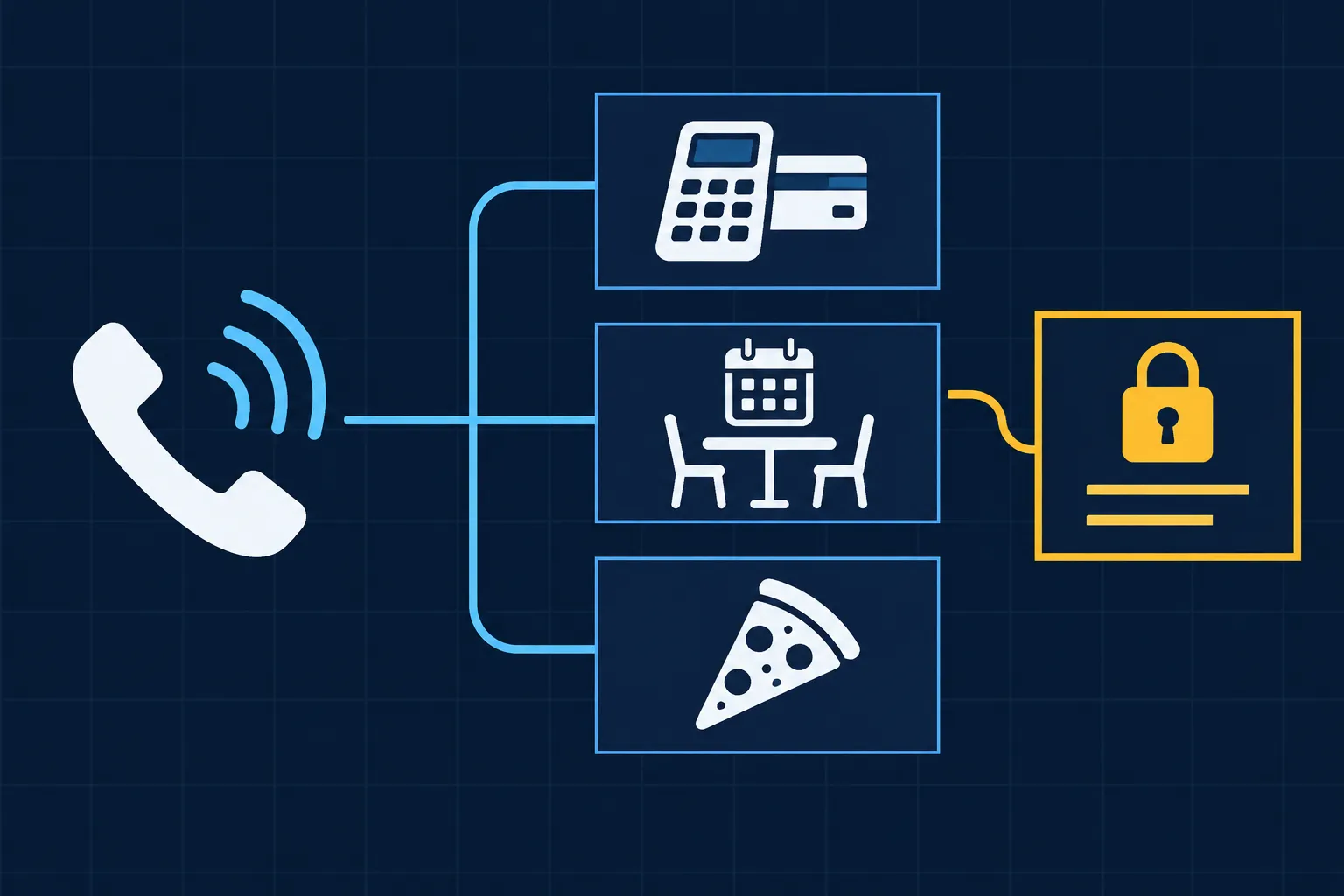
AI phone answering for a Canadian restaurant costs about C$180 to C$700 a month in voice-platform fees for 1,500 call minutes, according to our analysis of Vapi and Retell list prices in November 2026. It can answer hours questions, book tables and key takeout orders into the POS, but allergy questions and card numbers should never stay with the AI.
We build AI voice agents for Canadian businesses from Mississauga, so the SwiftBiz prices below are our published rates. Every other figure comes from a vendor's pricing or developer page, Statistics Canada, Restaurants Canada, or a federal agency or regulator, all checked on November 21, 2026.
Below: which restaurant calls to automate, how the agent reaches Toast, Square and Lightspeed, what OpenTable, Resy and Tock allow, the allergy, payment and recording rules, and a cost table.
Why are restaurants putting AI on the phone?
Because the phone keeps ringing while margins shrink and labour costs top operators' list of pressures. Statistics Canada reports that food services and drinking places sold $101.4 billion in 2025, up 5.6% from 2024, with full-service restaurants at $43.6 billion. Sales are growing, but profit is not following.
Restaurants Canada's Q4 2025 Quarterly Report found 44% of restaurants operating at a loss or breaking even as of November 2025, and labour costs cited as a concern by 89% of operators, just ahead of food costs at 88%. Its Q3 2026 report, released October 27, 2026, still had 67% of operators reporting lower profitability than a year earlier. The federal Canadian Industry Statistics summary for NAICS 7225 counts 89,054 full-service and limited-service establishments in 2025, 98.7% of them businesses with fewer than 100 employees, and an average hourly wage of $19.02 (2024 data).
That is the case in one line: a host who spends the 6 p.m. rush repeating your hours and parking details is paid staff time not spent on the guests in front of them.
Which restaurant calls should an AI answer?
An AI should take the repetitive, rules-based calls and hand everything with judgment or liability to a person. Here is the split we design to:
| Call type | AI handles it? | How |
|---|---|---|
| Hours, location, parking, patio, holiday closures | Yes | Answers from a short, owner-approved fact sheet |
| Reservations | Yes, if your booking platform allows it | Checks availability and books through the platform's partner API, or texts a booking link |
| Takeout and pickup orders | Yes, with guardrails | Reads the live menu, repeats the order back, sends it to the POS |
| Order status ("is my order ready?") | Yes, if the POS exposes it | Reads status from the POS |
| Catering and large-party inquiries | Partly | Collects date, headcount, budget and contact, then hands to the manager |
| Allergy and dietary questions | No | Warm transfer to staff, or a callback |
| Card payments | No | Sends a secure pay link by text |
| Complaints, refunds, delivery problems | No | Transfer or callback with the details captured |
For catering, the value is the capture, not the sale: a structured lead (date, guest count, dietary needs, budget, callback number) lands with the manager instead of a sticky note.
If you want this scoped against your own call mix, POS and booking platform, our AI Readiness Audit ($3,500, credited toward your retainer) maps which calls to automate before anything is built.
How does an AI phone agent put orders into Toast, Square or Lightspeed?
Through the POS vendor's own ordering API, which in each case needs approved access. The agent never "types into" the POS; it sends a structured order.
Toast. Toast's developer guide says you create an order by sending "a POST request that contains a JSON Order object to the /orders endpoint." Two details matter for phone orders. Payment is optional at creation, so the order can go in unpaid and be paid at pickup or by link. And the orders API does not check restaurant service hours, so it will create an order even when the restaurant is closed: the agent has to enforce your hours and kitchen cut-off itself. Toast says partner and custom integration access "is granted based on specific implementation requirements."
Square. The Square Orders API can record items, calculate totals and send fulfillment orders to the Square Point of Sale app and the Order Manager. The same page says pickup orders are pushed there once they are fully paid, so a pay-at-pickup order needs a different handoff, and it notes a 1% fee per transaction if a non-Square payment provider is used, so keep payment on Square.
Lightspeed. Montreal-based Lightspeed says access to its Restaurant (K-Series) APIs "is reserved for Lightspeed partners and approved merchants"; a merchant requests access through its account manager. Confirm with your Lightspeed account manager which ordering endpoints your location can use before any build is quoted.
The design rule across all three: the agent reads the live menu (items, modifiers, 86'd dishes) from the POS, repeats the full order back, and only then submits. An order that skips the read-back is where wrong modifiers come from. We test this the same way we test chat agents, with scripted calls that try to break the flow; the method is in how to test an AI chatbot before launch.
Can an AI phone agent book tables in OpenTable, Resy or Tock?
Sometimes, and only through each platform's partner channel. None of the three advertises a self-serve booking API you can switch on yourself.
- OpenTable lists Sync, Booking and CRM APIs for restaurants and tech providers, with a "Request access" form and a sandbox for approved partners.
- Resy describes real-time reservation sync with partner products but publishes no public API on that page; integration runs through Resy's partner relationships.
- Tock publishes no self-serve API sign-up that we could confirm, so ask Tock directly about API access before planning a direct booking flow.
Where a direct booking API isn't available, the fallback works well: the agent confirms party size and time, then texts the caller your booking-page link and logs the request. The guest finishes in two taps, and the platform stays the system of record.
Why must allergy questions go to a person?
Because a wrong answer can hurt someone, and an AI cannot see your kitchen. Health Canada's list of priority food allergens runs from peanuts, tree nuts and sesame to mustard, sulphites, and wheat and triticale. Whether a dish is safe depends on today's suppliers, shared fryers and cross-contact on the line, none of which sits in a menu file.
Our rule is fixed: any mention of an allergy, intolerance or "is this safe for" triggers a warm transfer to a staff member, or a logged callback during the rush. The agent may say which dishes are listed as containing an allergen if the restaurant has approved that wording, but it never says a dish is safe.
Can the AI take a credit card over the phone?
It shouldn't. Have the agent text a secure pay link instead. The PCI Security Standards Council's guidance, Protecting Telephone-Based Payment Card Data (version 3.0, November 2018), states: "Sensitive authentication data (SAD) must not be stored after authorization, even if encrypted." For phone calls, SAD includes the card security code a caller reads out.
A voice agent transcribes and often records every word, so a spoken card number lands in transcripts, logs and recordings. The same document says that where VoIP carries card data, "the entity's systems and networks used for those transmissions are in scope," and it points to technology that lets the cardholder enter card data into a secure webpage "via a secure link provided via SMS or e-mail." That is the design: the agent sends a pay link from your processor (Toast, Square or Lightspeed payments), and card data never touches the call. If a caller starts reading a number anyway, the agent interrupts and redirects.
Do you have to tell callers the call is recorded?
Yes, if you record. The Office of the Privacy Commissioner's guidance on recording customer telephone calls says an organization "must inform the customer that they are recording a call," and that the purpose "should be stated to the customer as clearly and narrowly as possible." Put a one-sentence notice at the start of every call, such as "This call is answered by an AI assistant and recorded to process your order." Our AI receptionist guide for Canada covers PIPEDA consent and Quebec's French-language rules in more depth.
How much does AI phone answering cost a restaurant?
On our analysis, platform fees for 1,500 call minutes a month (25 hours of talk time) run about C$180 to C$700, and a managed SwiftBiz voice agent starts at $4,500 CAD a month.
| Option | Monthly cost (CAD) | What you get | Best for |
|---|---|---|---|
| Build on Vapi, 1,500 min | about C$193 to C$294 | Platform, speech, model and voice, plus Twilio inbound at US$0.008/min | A team with a developer to build and maintain the flows |
| Build on Retell, 1,500 min | about C$183 to C$698, plus C$2.87 per number | Platform at US$0.07 to US$0.31/min plus US$0.015/min telephony | Same, with simpler itemized billing |
| Staff time for the same 25 hours | about C$476 in wages, before payroll costs | A person, but not during the rush when they are needed elsewhere | Low call volume, or calls that need judgment |
| SwiftBiz Essential Line | $4,500/mo | 1 phone line, call routing and FAQ, CRM logging | One location that mainly needs calls answered and logged |
| SwiftBiz Smart Routing | $9,000/mo | Multi-line support, booking, human escalation | Multi-line restaurants that need booking and live transfer |
| SwiftBiz Full Coverage | $20,000/mo | Complex call flows, analytics dashboard, multi-location | Restaurant groups with several locations |
Sources: Vapi pricing (calculator estimate US$0.082 to US$0.129 per minute at 1,000 minutes), Retell AI pricing, and the Bank of Canada rate of 1.4325 for November 20, 2026. Method: per-minute rate plus telephony, times 1,500 minutes, converted to CAD and rounded; taxes and overage excluded. Staff line, our analysis: 25 hours at the $19.02 NAICS 7225 average wage from the ISED industry summary. SwiftBiz tiers and inclusions are from our AI voice agents page; which tier a POS-connected ordering flow needs depends on scope, and current terms are on pricing. All SwiftBiz prices are in Canadian dollars (CAD).
The platform fee is the small part. The work is the POS and booking integration, the menu sync, the allergy and payment guardrails, and testing. That is what separates a demo from an agent you can leave on during Friday dinner. For a platform-by-platform breakdown, see Vapi vs Retell vs Bland.
Illustrative example. The figures show what this build is designed to achieve, not a measured client result. A two-location pizzeria with Square takes most takeout orders by phone. The agent answers every call, repeats each order back, texts a Square pay link, sends the paid order to Square for pickup, and transfers allergy questions to the counter. Our target for a build like this is 20+ hours saved per week across both locations, with the first production workflow live in 4 to 8 weeks.
When is AI phone answering not worth it?
For many single-location restaurants, a managed agent at $4,500 a month costs more than the problem. Scoped verdicts:
- Under a few hundred calls a month, one location: choose your POS's built-in online ordering plus a voicemail that texts the ordering link. Don't pay for a managed agent.
- A developer on staff and a simple menu: start with Vapi or Retell and build it yourself for a few hundred dollars a month in fees, and budget the testing time.
- Fine dining where the call is part of the hospitality: we recommend keeping a person on reservations and using AI only for after-hours overflow.
- Several locations, high takeout volume, POS and booking integrations, French and English callers: choose a managed, tested agent; this is where it earns its cost.
We take on 3 new clients per month. We are a team of 4 people, founder-led.