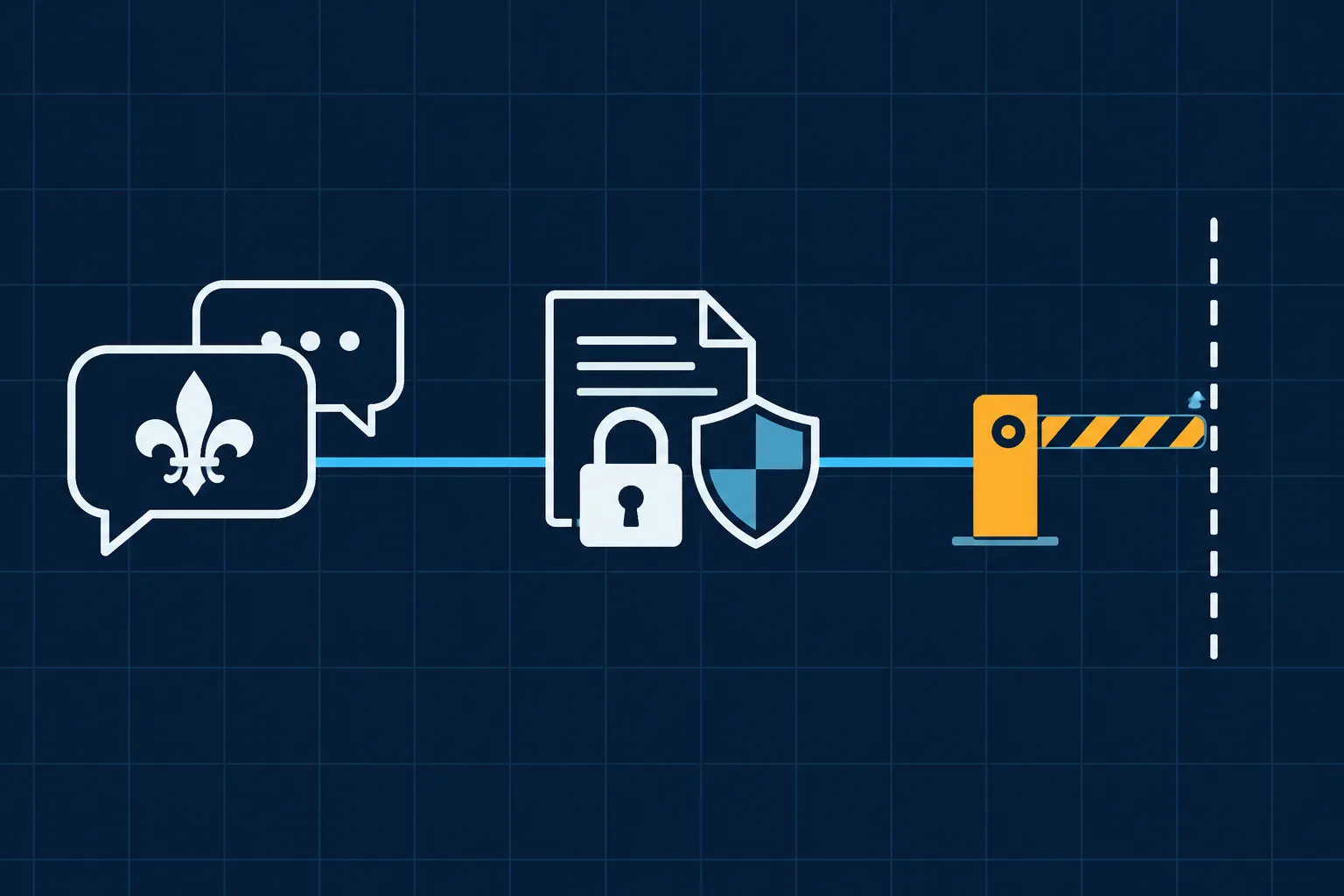
A chatbot that serves Quebec customers has to meet two Quebec laws at once. The Charter of the French Language gives consumers the right to be informed and served in French. Law 25 requires a privacy impact assessment for the project, notices at collection, disclosure of fully automated decisions, and an assessment plus a written agreement before chat data leaves Quebec. SwiftBiz turns this into 8 launch checks.
SwiftBiz builds AI chat agents for Canadian businesses from Mississauga, Ontario, and our scoping for a Quebec-facing bot starts from the statute text itself. For this post we read both acts on LégisQuébec (consolidated to October 15, 2026), the Commission d'accès à l'information's Law 25 summary, an OQLF enforcement notice and Microsoft's region documentation. Below: what each law asks of a chatbot, the 8 checks, where data may go, cost, and the penalties as written.
Which Quebec laws apply to a customer-facing chatbot?
Two, and they answer different questions. The Charter of the French Language decides which language the bot uses. Quebec's Act respecting the protection of personal information in the private sector, as amended by Law 25 (2021, c. 25), decides what the bot may collect, what it must tell people and where the data may go.
| Law | Section | What it says | What it means for our chatbot builds |
|---|---|---|---|
| Charter of the French Language | s. 5 | Consumers "have a right to be informed and served in French" | The bot must work in French |
| Charter (added by Bill 96, 2022) | s. 50.2 | An enterprise offering goods or services to consumers "must respect their right to be informed and served in French" | French service from the first message, not a hidden option |
| Charter | s. 52 | Catalogues, order forms and similar documents, "regardless of the medium used", in French; another language only if French is available on terms at least as favourable | Product answers, quotes and forms the bot produces |
| Private-sector privacy act | s. 3.3 | Privacy impact assessment for any project to acquire, develop or overhaul an information system or electronic service delivery system involving personal information | A chatbot that collects names, emails or order details is such a project |
| Private-sector privacy act | s. 8 and 8.1 | Notices at collection, including the possibility of communication outside Québec; prior notice of technology that can identify, locate or profile | The opening message and the privacy policy |
| Private-sector privacy act | s. 12.1 | Notice of a decision "based exclusively on an automated processing" | Bots that approve, deny or price without a person |
| Private-sector privacy act | s. 17 | Assessment and "written agreement" before communicating personal information outside Québec | Your model API, hosting and CRM |
This post is written for businesses that serve Quebec consumers. If you are federally regulated or rarely deal with Quebec, check how far each act reaches you first. Whether the Charter reaches a business with no establishment in Quebec is a question for a Quebec lawyer.
Does the chatbot have to answer in French?
On our reading, yes, if it serves consumers in Quebec. Section 50.2 of the Charter of the French Language says an enterprise that offers goods or services to consumers "must respect their right to be informed and served in French", and for a public other than consumers it "must inform and serve it in French". The section does not carve out any channel, so we treat the chat window as one more place a customer is informed and served.
What that looks like in a build:
- French first or French on equal terms. The greeting is in French, or offers French with the same prominence as English. We do not ship a French mode that only appears after the user happens to type in French.
- French source content. Translating an English knowledge base on the fly drifts on product names, prices and policy terms. Our build plan loads French source documents.
- French documents out of the bot. Section 55 covers contracts of adhesion and section 57 invoices and receipts. If the bot sends a quote, confirmation or terms, a French version has to exist.
The OQLF enforces the website rules. In a November 14, 2025 notice, it reported that Waterco pleaded guilty on October 9, 2025, to an offence under section 205 of the Charter and was fined $3,000. After a complaint that commercial content on its website was available only in another language, the company was charged with failing to comply with an order issued under the Charter. The notice states that section 52 "includes publications of this nature" on a website (our translation).
What does Law 25 require before the chatbot goes live?
A privacy impact assessment, clear notices and a plan for automated decisions. Section 3.3 of the private-sector privacy act requires an assessment "for any project to acquire, develop or overhaul an information system or electronic service delivery system involving the collection, use, communication, keeping or destruction of personal information". The person in charge of protecting personal information must be consulted "from the outset of the project", and the assessment is proportionate to the data involved.
Three more sections shape the conversation itself:
- Section 8, notice at collection. The person must be told the purposes, the means, their rights and, if applicable, "the possibility that the information could be communicated outside Québec", in "clear and simple language".
- Section 8.1, identify, locate or profile. If the bot uses technology with functions that can identify, locate or profile the person, it must first tell them and explain how to activate those functions. Profiling means using personal information "to assess certain characteristics of a natural person", such as preferences or behaviour. The CAI's Law 25 summary reads this as: these functions cannot be on by default. A bot that scores leads from chat behaviour or reads location belongs here.
- Section 12.1, automated decisions. A business that uses personal information "to render a decision based exclusively on an automated processing" must tell the person "not later than at the time it informs the person of the decision". On request it must explain the personal information used, "the reasons and the principal factors and parameters" and the right to correction, and give the person the chance to submit observations to a staff member "in a position to review the decision".
A bot that answers questions or books the slot the customer picks decides nothing about them. One that approves a return, denies an application or sets a price from someone's answers may. We recommend a simple default: the bot drafts and routes, and a person makes any decision that refuses or charges. Our post on chatbot liability in Canada covers the wider accountability question.
Can chat data be sent outside Quebec?
Yes, but only after an assessment and under a written agreement. Section 17 says: "Before communicating personal information outside Québec, a person carrying on an enterprise must conduct a privacy impact assessment." The assessment must weigh the sensitivity of the information, the purposes, the protection measures "including those that are contractual", and the legal framework of the destination. The transfer may go ahead if the assessment shows "adequate protection", and it "must be the subject of a written agreement". The same applies when someone outside Québec collects, uses or keeps the information for you, which describes most chatbot vendors.
The statute says outside Québec, not outside Canada. On that plain wording, a model API in the United States, a CRM hosted in Virginia and a server in Toronto are all outside Québec. Here is where common hosting choices sit, from Microsoft's documentation as of November 21, 2026:
| Setup | Where prompts are processed | Inside Québec? | Source |
|---|---|---|---|
| Azure OpenAI, Global deployment | "May be processed in any Azure region" | No guarantee | Microsoft Learn, deployment types |
| Azure OpenAI, Standard deployment in Canada East | Within the Canada geography; "might be processed between regions within that geography" | Not guaranteed: the Canada geography also includes Toronto | Microsoft Learn |
| Azure region Canada Central | Located in Toronto | No | Microsoft Learn, regions list |
| Azure region Canada East | Located in Quebec | Region is in Quebec; check each service's storage and processing terms | Microsoft Learn |
| US-hosted model API or SaaS chatbot | Vendor's US regions | No | Vendor terms |
For most businesses we recommend not forcing everything into Quebec. Choose instead to assess each vendor in the data path, sign agreements covering training use, retention, subprocessors and incident notice, say in the section 8 notice that information may leave Quebec, and send the model only what it needs. Our PIPEDA-compliant AI automation guide has the vendor-terms checklist we use for the federal side.
What are the 8 checks before a Quebec chatbot launches?
These are the 8 checks in SwiftBiz's launch plan for a Quebec-facing chat agent.
- Name the person in charge. Under section 3.1 the person with the highest authority holds this role unless it is delegated in writing; the title and contact information go on your website.
- Run the project assessment. Do the section 3.3 assessment at the start, with that person involved, sized to the data the bot will collect.
- Map every data hop. List the model API, hosting, logging, CRM and email tools, and mark which ones sit outside Québec.
- Assess and sign for each transfer. Complete the section 17 assessment for each hop outside Québec and put a written agreement in place before launch.
- Write the opening notice. In French and in clear language: that it is an automated assistant, why it collects information, the rights, and that information may be communicated outside Québec.
- Turn off profiling and location by default. Lead scoring from behaviour, location lookups and identity matching stay off until the person activates them (section 8.1).
- Route decisions to a person. Anything that refuses, approves or prices goes to staff, or carries the section 12.1 notice and a review path.
- Test in French. Run the same test set in both languages, including handoff, quotes and confirmations. Our chatbot testing checklist has the method.
What does a compliant Quebec chatbot cost?
The legal work adds scope, not a separate product. A single-language FAQ bot fits the AI Chatbot Starter at $8,000 one-time. A bilingual English and French bot with French source documents, testing in both languages, a documented assessment and a controlled data path pushes it toward the Custom Enterprise Chatbot range ($12k to $30k, quoted per project). All prices are in Canadian dollars (CAD), and the full list is on our pricing page.
Illustrative example: a Montreal-area online retailer wants a bilingual order-status and returns bot. It answers in French first, reads order status from the store, hands refund decisions to staff, and has a section 17 assessment and agreement for the US model API. Our target for a build like this is 20+ hours saved per week on order-status emails, with the first production workflow live in 4 to 8 weeks.
Illustrative example. The figures show what this build is designed to achieve, not a measured client result.
If you are not sure which of the eight checks your current bot fails, our AI Readiness Audit ($3,500, credited toward your retainer) can be scoped to map your data path and return the gaps in writing. We take on 3 new clients per month.
What are the penalties?
These are the statutory figures; how they apply depends on the facts.
| Law | Section | Penalty as written |
|---|---|---|
| Private-sector privacy act | s. 90.1 and 90.12 | Monetary administrative penalty up to $50,000 for a natural person and, in all other cases, $10,000,000 or, if greater, 2% of worldwide turnover for the preceding fiscal year. Section 90.1 lists failing to give the section 12.1 notice or the chance to submit observations as one of the grounds |
| Private-sector privacy act | s. 91 | Fine of $5,000 to $100,000 for a natural person and, in all other cases, $15,000 to $25,000,000 or, if greater, 4% of worldwide turnover, for offences such as using or communicating personal information in contravention of the law |
| Charter of the French Language | s. 177, 205 and 207 | The OQLF may order a business to comply. Contravening that order carries a fine of $700 to $7,000 for a natural person and $3,000 to $30,000 in other cases, doubled for a second offence and tripled after that |
When is the full checklist not worth it?
If your chatbot collects no personal information (no name, email, phone or order number) and only answers public product questions, the Law 25 checks shrink to the notice and the privacy policy, and the Starter is the better fit. You still need French. If you have no Quebec customers and do not market there, the Charter rules are unlikely to be your first concern. If your bot makes credit, insurance or eligibility decisions, start with a Quebec lawyer before any agency starts work.
Our AI chat agents service builds bilingual bots with these checks in the plan from day one.
Written by Harry, Founder & Lead AI Engineer at SwiftBiz. Statutes were read on LégisQuébec, consolidated to October 15, 2026; CAI, OQLF and Microsoft pages were read on November 21, 2026.