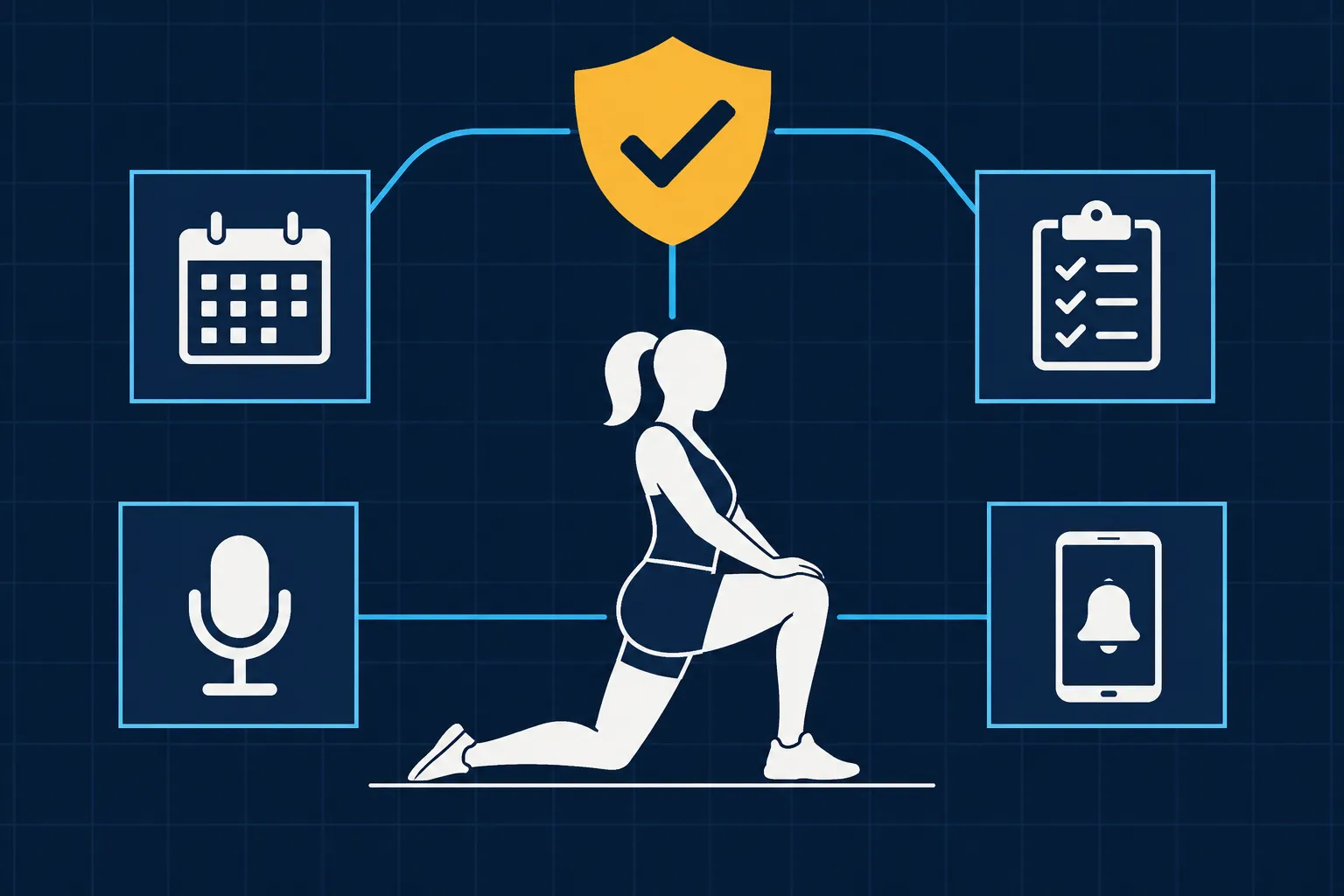
The College of Physiotherapists of Ontario names four places PTs now use AI: booking and intake forms, triage routing, AI scribes and home exercise reminders. Its July 2026 update adds no new rules. The physiotherapist stays accountable for judgment, privacy, documentation and safe care. SwiftBiz builds the admin side so each AI output is a draft a registered PT approves.
SwiftBiz builds booking agents and intake workflows for Ontario service businesses, clinics included. For this post we read the College's AI principles, its July 2026 update, its AI scribe guide and three practice standards end to end, plus the WSIB physiotherapy fee schedule and HCAI's OCF-18 instructions. Below: what the College actually said, the five tasks, a who-owns-what table, costs and who should wait.
What did the College of Physiotherapists of Ontario say about AI in 2026?
It said AI has moved from emerging to embedded, and that accountability has not moved at all. In a July 21, 2026 post, Registrar and CEO Craig Roxborough wrote that physiotherapists are using AI tools to:
- "Assist with online forms or screening questions during booking or intake"
- "Send patients to the right service during triage"
- "Support documentation – using AI scribes to draft notes or document the visit"
- "Help with home exercise programs – sending reminders, gathering updates from the patient or guiding exercises"
The key sentence for a clinic owner: "AI may change how some parts of care are delivered, but it does not change who remains responsible." The post lists four things PTs are still responsible for: clinical judgment, meeting privacy requirements, proper documentation and delivering safe care.
The update itself changed wording, not obligations. It added "Quick Checks" to each principle, clarified transparency obligations and shifted from bias awareness to managing bias risk. The underlying Artificial Intelligence: Principles for Physiotherapists guidance states plainly that it "does not set out new professional requirements." The rules that bite are the existing standards and statutes it points to, including PHIPA and the College's Documentation standard.
What is the TRUST framework, and what does it require of a clinic?
TRUST is the College's memory aid for AI: Transparency and Consent, Responsibility, Understanding Bias and Limitations, Security, and Training. Each letter maps to obligations a PT already has. For a clinic deploying automation, four of its listed actions matter most:
- Consent before clinical use. "Obtain consent prior to using AI to aid in the delivery of clinical care, including for record keeping." An AI scribe is record keeping, so it needs consent first.
- Drafts, not decisions. "Tell your patients that AI-generated outputs are drafts that are reviewed by physiotherapists before being used."
- A non-AI path. "Be ready to use alternate options if a patient is uncomfortable with the use of AI as part of their treatment."
- Admin AI is not invisible. "To the extent possible, be transparent about how AI is embedded in administrative systems and used for non-clinical tasks." That covers your booking bot.
Two more lines shape vendor choices. Under Responsibility, the College tells PTs to treat AI the way they would supervise "delegates (e.g., students or PTAs)." Under Security, it says that where tools are "selected, embedded, or required by the workplace, physiotherapists remain accountable." An owner cannot buy a tool and make the risk the vendor's problem, and an employed PT cannot point to the owner. The privacy mechanics of a booking bot (custodian, agent, consent, breach) are in our PHIPA checklist for AI booking bots; we don't repeat them here.
Which clinic tasks can AI take on, and what stays with the physiotherapist?
Five tasks are worth automating, and each has a clear line where the PT takes over. This is our working table for scoping a physiotherapy build, an owned design rule rather than a College requirement:
| Task | What the AI does | What stays with the registered PT | Standard or source that applies |
|---|---|---|---|
| Booking and reception | Answers calls and chats, books into the calendar, sends confirmations | Nothing clinical; the bot books, it does not triage symptoms | AI Principles (transparency for admin AI); PHIPA |
| Intake forms | Collects history and goals, structures it for the chart | Reviewing it, and the assessment and diagnosis | Documentation standard |
| AI scribe notes | Drafts the treatment note from the session | Editing, approving and signing the entry | AI scribe guide; Documentation standard |
| Home exercise reminders | Sends the PT's program on schedule, collects patient check-ins | Setting and changing parameters; reading flagged replies | AI Principles (Responsibility) |
| WSIB and insurer paperwork | Pre-fills Form 8, the physiotherapy assessment report and OCF-18 fields | Clinical content, sign-off, everything billed under their number | Funding, Fees and Billing standard |
Booking. The College's own backgrounder notes that patients "might be less interested in treatment recommendations, but satisfied with AI chat bots for booking appointments." That is the low-risk entry point. Our rule: the agent says it is an AI in its first line, offers a person on request, and ends the flow with a staff transfer or a 911 instruction at any red-flag phrase.
Intake. AI can turn a web form into structured history, but the PT still owns the record. The Documentation standard requires records that are "accurate, legible, complete, and written in a timely manner," that the person delivering care is "clearly identified in all documentation," and that changes show who made them and when. Your intake tool needs an audit trail, not just a summary.
AI scribes. The College's AI scribe guide describes the PT reviewing and editing notes "in real-time and/or before entering them as part of the patient's record." It warns that a scribe not trained on physiotherapy "might not recognize words like 'kinesio taping' or 'plinth.'" If a patient declines: "be ready to take notes without the help of AI." Records must be kept for at least 10 years from the last adult encounter, so check where the vendor stores audio and drafts, and for how long.
Home exercise reminders. Sending the program and collecting "how did it go" replies is admin. Changing sets, load or frequency is a treatment parameter, which the Documentation standard expects in the treatment plan. Any reply reporting new pain goes to the PT, not to an automated reply.
WSIB and auto insurance. The WSIB physiotherapy fee schedule (updated January 23, 2026) pays $50.00 for an electronically submitted health professional's report (code 8M1E) against $40.00 on paper, and $18.41 for the physiotherapy assessment report (P970), completed "when physiotherapy treatment begins." It says to "Submit only one Form 8 for each worker." For motor vehicle claims, HCAI states that "All OCF-18s must be submitted via HCAI." Automation can pre-fill these from the chart and catch a duplicate Form 8. The Funding, Fees and Billing standard is blunt about who answers for the result: the PT "Is responsible for all billing under their registration number."
What does it cost, and when does it pay back?
SwiftBiz pricing is public and in Canadian dollars: an AI Readiness Audit is $3,500, credited toward your retainer. A standalone chat agent that answers questions from your own content can start from the AI Chatbot Starter at $8,000 one-time. A booking agent that writes to your practice system, and multi-workflow builds (booking plus intake plus paperwork), run on monthly retainers from $4,500/month; see pricing for what each tier includes. Our target is 20+ hours saved per week, with the first production workflow live in 4 to 8 weeks.
Here is how close a clinic with four PTs and one front desk could get to that target:
| Admin task | Hours per week before | Target after |
|---|---|---|
| Finishing notes after hours (4 PTs × 30 min × 5 days) | 10 | 4 (PT still reviews each draft) |
| Re-typing intake forms into the chart | 5 | 1 |
| Reminder, rebooking and voicemail callbacks | 7 | 2 |
| Preparing Form 8, P970 and OCF-18 drafts | 5 | 2 |
| Total | 27 | 9 (18 hours saved, just under our 20+ target) |
Illustrative example. The figures show what this build is designed to achieve, not a measured client result.
Note the scribe line keeps four hours: review time is the College's requirement, not waste to be removed. Error reduction of up to 90% is our design target for structured re-keying (intake to chart, chart to form).
If you want this table filled in with your clinic's real numbers, book an AI Readiness Audit and we will map each task to who owns it before any tool is chosen.
Which tools does it connect to?
A typical Ontario physiotherapy clinic runs a practice management system (Jane or Juvonno, for example), plus a phone line and a web form. Where the system offers an integration route, a booking agent writes to its calendar and an intake workflow writes structured fields to the chart; where it does not, the agent hands the patient to your existing online booking page and staff file the intake summary. Jane says it has no open API, so we confirm the route during the audit before anything is quoted. Insurance automation reads the chart and prepares WSIB forms for submission through wsib.ca/submit and OCF-18s for HCAI. We build these as AI chat agents and workflows around your existing software, not a replacement for it. For the wider clinic picture, including no-show reminders, see our guide to AI automation for health and wellness clinics and the AI automation for clinics page.
Does an AI-written ad or website need checking against the Advertising standard?
Yes. The College's Advertising and Marketing standard requires advertising that is "truthful, accurate, and verifiable," bans "guarantees of successful outcomes" and claims of superiority, and makes the PT review ads "placed by themselves or others on their behalf." Copy drafted by an AI tool or an agency counts. Our recommendation: no AI-generated recovery promises on the site or in the booking bot's script, and a named PT signs off on both.
Who is this not for?
Choose to wait if any of these apply:
- You have no designated privacy lead. Every TRUST action assumes someone owns consent wording, vendor terms and retention. Appoint one first.
- You want the bot to triage symptoms. Routing by service type is fine; assessing a patient's complaint is clinical judgment. We don't build that.
- Your PTs won't review scribe drafts. If notes would be signed unread, an AI scribe adds risk instead of time. Skip it and start with booking.
- You see fewer than about 40 visits a week (our rule of thumb, not a benchmark). The admin load may not justify a build; a well-configured online booking page may be enough.
For most multi-PT clinics, the best first step is booking plus intake: lowest clinical risk, clearest audit trail, and the College has named both as current practice.